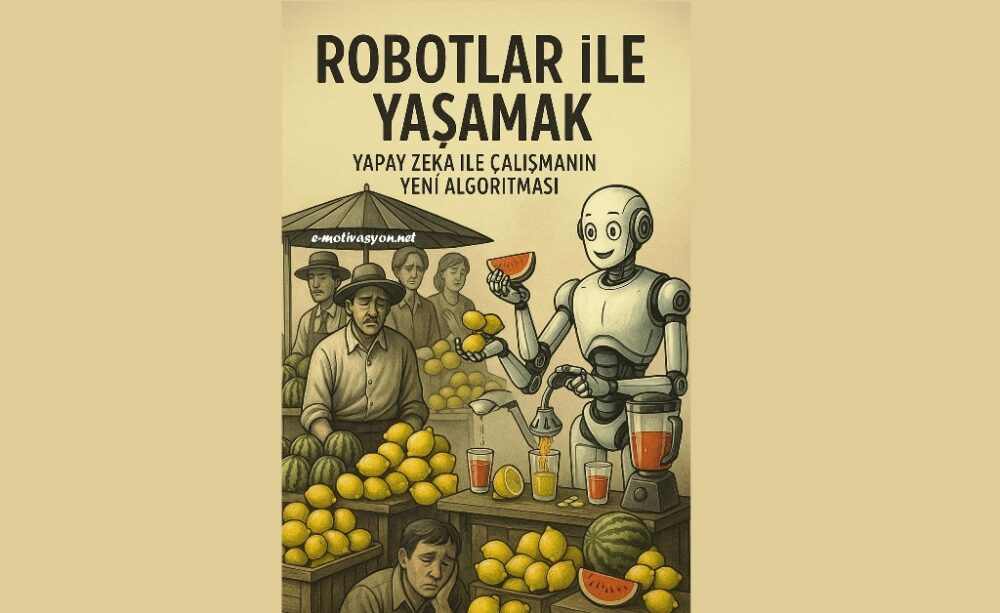

Living with Robots: The New Algorithm for Working with Artificial Intelligence
A New Turning Point in Human History
Once upon a time, the biggest concern for people selling lemons was the freshness of the lemons and the cost of purchasing them. Today, the very existence of this profession is being questioned. Artificial intelligence is rapidly replacing not only knowledge work but also traditional labor-intensive jobs. According to 2023 data from the McKinsey Global Institute, by 2030, 375 million people worldwide (14% of the workforce) may need to change jobs due to automation and artificial intelligence. This transformation is being felt not only in the manufacturing and service sectors, but in every field, from banking to journalism, entertainment to education. . .
The robot in the image is not merely symbolic, but also points to a functional reality. Today, a person can perform dozens of tasks simultaneously with AI-powered systems. Just imagine what robots will be capable of in the future. According to research by Oxford University, 47% of current jobs are at risk of automation within 20 years. By 2025, 60% of robots used in manufacturing will be AI-powered, sensor-based, decision-making systems. Not only physical tasks but also mental workloads are beginning to be taken over. For example, such robots working on an e-commerce platform analyze customer trends, suggest campaign strategies, and perform automatic price updates. .. . .
Jobs of the Future: Who's Got a Spot?
Artificial intelligence is changing not only professions but also the definitions of professions. Some new professions that will be popular in the future include: Artificial Intelligence Ethics Specialist, Data Privacy Consultant, Human-Machine Relations Coach, Virtual Reality Therapist, Algorithmic Agricultural Engineer, Digital Rehabilitation Specialist, Creative Story Coder. If you notice, almost all of these professions are based on the “technology + human” balance. The issue now goes far beyond working against robots; it will be about finding ways to coexist with them. . . . . . . . .
The future will continue to smile upon those who have adapted to this new way of working. But the future of work will continue to reward those who are most adaptable to technology, who have high emotional intelligence, and who can think creatively. According to the World Economic Forum's 2025 forecasts, the most in-demand skills will include: Complex problem solving, Critical thinking, Creativity, Emotional intelligence, People management, Cognitive flexibility. In other words, robots can squeeze lemons, but “adding meaning to sourness” will still be the job of humans. Even though artificial intelligence is transforming professions, humans' search for meaning continues. As beings who question “why we work,” “how we contribute,” and “our place in this world,” we must adapt to this new reality as soon as possible. . . . ... . .
Throughout history, we have seen that every new technological revolution carries within it both “opportunities” and “threats.” From the steam engine to the printing press to the internet, each revolutionary innovation has fundamentally changed the business models of the working world. However, humanity has always found a way to create new value for itself. Today, what is needed is not panic, but preparation. We need to reposition ourselves not merely as “people with a profession,” but as “people capable of continuous transformation.” We must seek and find new ways to be carriers of our competencies, not our professions. . ve bir . . . . . . . . .
References:
McKinsey Global Institute. (2017). Jobs lost, jobs gained: Workforce transitions in a time of automation. McKinsey & Company. https://www.mckinsey.com/featured-insights/future-of-work/jobs-lost-jobs-gained-what-the-future-of-work-will-mean-for-jobs-skills-and-wages

World Economic Forum. (2020). The future of jobs report 2020. https://www.weforum.org/reports/the-future-of-jobs-report-2020
PwC. (2018). Will robots really steal our jobs? An international analysis of the potential long-term impact of automation. https://www.pwc.com/gx/en/issues/analytics/assets/pwc-ai-analysis-sizing-the-prize-report.pdf
MIT-IBM Watson AI Lab. (2021). The future of work: How new technologies are transforming tasks. https://mitibmwatsonailab.mit.edu/research/the-future-of-work-how-new-technologies-are-transforming-tasks
World Economic Forum. (2020). Jobs of tomorrow: Mapping opportunity in the new economy. https://www.weforum.org/reports/jobs-of-tomorrow-mapping-opportunity-in-the-new-economy
Upwork & Freelancers Union. (2021). Freelancing in America: 2021 report. https://www.upwork.com/research/freelancing-in-america
Future Life and the Future of Professions with Artificial Intelligence