Buridan's Ass: Indecision in an Age of Choice

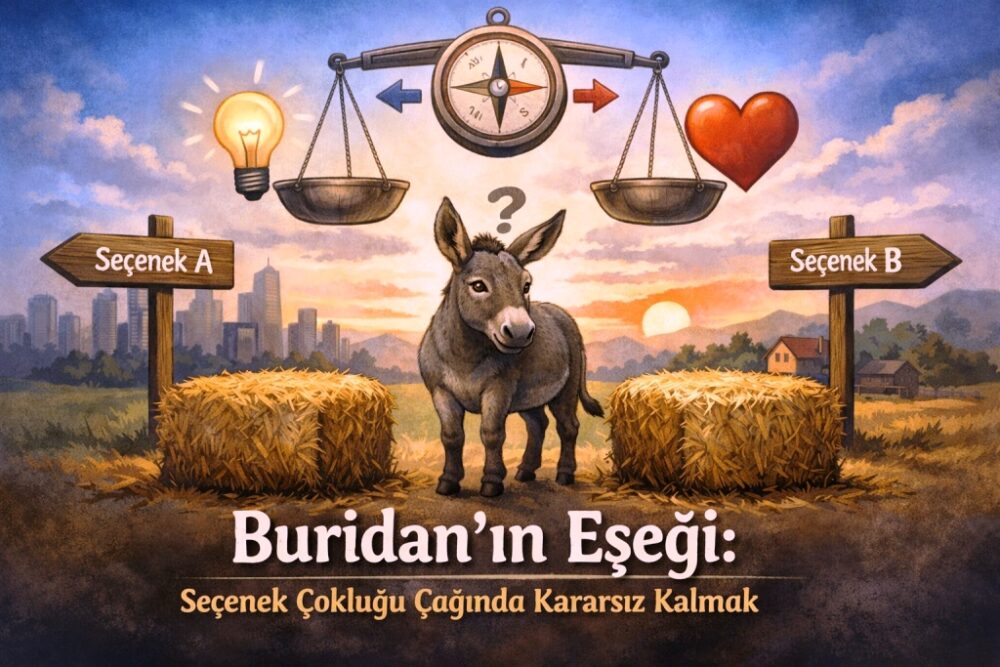
Buridan's Ass is a classic philosophical thought experiment used to explore indecision and the limits of pure rationality. The story is briefly as follows: A donkey is placed right between two completely equal piles of hay. Both piles are the same distance away, the same size, and equally appealing. The donkey cannot find any rational reason to choose one over the other. Ultimately, it cannot decide and dies of starvation.
This thought experiment is usually attributed to the 14th-century philosopher Jean Buridan; however, interestingly, Buridan does not directly use this example in his writings. It seems more like an example that was invented later to criticize or discuss his views on the relationship between reason and will.
Buridan's Ass appears, at first glance, to be a simple philosophical tale: an ass caught between two equal piles of hay starves to death because it cannot decide which to eat. However, what makes this story meaningful today is not so much the story itself as the mirror it holds up to us. Today, people are not caught between haystacks; they are caught between careers, relationships, lifestyles, education, cities, and even questions like “Which task should I start with?” As options multiply, we think we become freer, but often the opposite is true: mental paralysis.
Buridan's Ass illustrates several critical issues:
- Is pure rationality sufficient? If decision-making relies solely on logical comparisons and the options are completely equal, the system becomes locked. This suggests that humans need not only reason but also elements such as will, emotion, intuition, or chance.
- Indecision is also a decision. The donkey chooses “not to choose.” Similarly, in daily life, not making a decision often leaves us at the mercy of external circumstances, and the price can be high.
- Motivation perspective: A person stuck between options that appear completely equal often loses energy. Motivation is reignited by a small difference in meaning, feeling, or inner drive. In other words, what motivates people is not always “the most logical choice.”
Based on this information, the following question comes to mind: Are there really two equal options in real life, or are we avoiding creating a perspective that makes a difference?
This story is surprisingly close to what modern psychology calls “decision paralysis.” Whether there are two or twenty-two options, the mind reacts the same way: it compares, measures, weighs... and eventually tires. Buridan's Ass whispers here: The problem is not the equality of the options, but the burden of the decision on the mind alone. Humans are not merely rational beings; they have emotions, intuitions, values, and a search for meaning. When these are sidelined, even the most “rational” mind cannot move.
From a motivational perspective, this narrative becomes even more striking. Motivation often arises not from “finding the right option,” but from assigning meaning to an option. The donkey dies because there is no difference in meaning between the haystacks. Humans often remain stuck for the same reason: they get caught up in the question “Which is better?” but fail to ask “Which do I want?” Yet motivation is fueled not by the perfect choices of the external world, but by the clarity of the internal world.
Buridan's Ass is valuable for this reason; because it reminds the reader: Indecision is not a problem of intelligence, but a problem of direction. Those who progress in life are not always those who make the best choice; they are those who own up to their choice after making it. Sometimes a small intuitive step is more transformative than a long logical walk. Because action begets motivation; motivation is not gained by waiting, but often by taking action.

In short, Buridan's Ass tells us this: Life is not a table where we can weigh equally appealing options forever. At some point, we must put down the scales and take a step. And that step may not always be the “most logical” one; it may be the one that feels most alive.
Two Familiar Buridan Examples from Everyday Life
An example from professional life illustrates the “Two Good Options” trap: the current job is secure, the salary is good, and the environment is familiar. The other option is more uncertain but promises learning and growth. Both options are “reasonable.” Months pass, no decision is made, motivation drops, mornings become difficult. Buridan's Ass shows us that the problem is not the quality of the options, but the person's inability to clarify which life they want to pursue. The decision is not hidden in the question “which is better?” but in the question “who do I want to be?”
An example of indecision in relationships is when a relationship is neither very bad nor truly fulfilling. “It's not bad enough to leave, but not good enough to stay.” The mind weighs the pros and cons, but the heart grows silent. Time passes, and the person remains suspended both in the relationship and in their own life. This situation is the emotional version of Buridan's Ass. Indecision does not preserve the relationship; it slowly drains its energy. Yet sometimes a decision is necessary not for the future of the relationship, but for the person to reconnect with themselves.
3 Coaching Questions That Empower You in Moments of Indecision
What killed Buridan's donkey was not the equality of choices, but the disabling of its internal compass. The following questions are designed to quiet the mind and reorient you:
- Which of these two options makes me feel more “alive”? This question speaks to the body and emotions, not logic. An increase in energy is often a strong clue about the right direction. Peace, excitement, or curiosity... Whichever one becomes clear, there is a call to action there.
- If I didn't make this decision, what would my regret be in 6 months?The mind exaggerates the present; regret is a mirror of the future. This question reveals long-term values, not short-term fears.
- What if I chose the first step instead of the perfect choice? This question shifts the decision from being about the “outcome” to being about the “process.” Motivation often arises not from the right decision, but from taking action. Once the first step is taken, the next steps become clear on their own.
Progress in life is not always about finding the right option. Sometimes progress is about choosing an option and then making it right. That is why Buridan's Ass is still relevant today. Because the greatest hunger of our age is not for food; it is for direction.