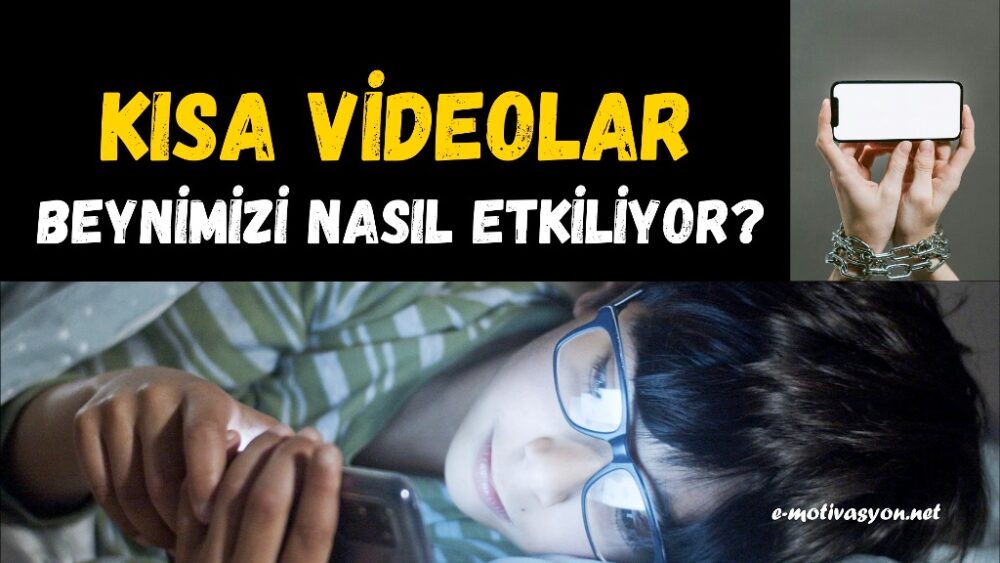

How Do Short Videos Affect Our Brain?
Scientific Facts and Solutions
The short videos we view hours a day may be more detrimental than we are aware. Watching short videos these past few years has some bad effect on our brain, which we do not know. If you can't help doing this and have no idea how the hours slip by watching them, alarm bells can be ringing for you.
Our attention, our ability to focus, and even our ability to think in the long term are greatly affected by this video trend. Short videos that we use for a momentary relaxation or for getting information can damage our ability to think in the long term when consumed indiscriminately.
Then what are the causes and solutions? Let us see closer in the context of scientific evidence.
Shortening of Attention Span
With the life of today, individuals have started to have shorter attention spans. Distraction has become the normal and usual thing. We now need more energy and reasons to focus on something.
Social networking sites hold a large place in the lives of individuals of today. These sites, which we initially used for interaction and communication, have become a universe where we spend our lives. This has also become a marketplace that brings together content creators and consumers. Short videos have become the fastest way for content creators to convey. Because it takes focus and attention to read an article. It is easier to watch and has a much stronger effect on our minds.
. . Short videos have a mechanism of habituating our brain to immediate reward. Quickness of watching one video and then moving on to another gets the reward system of the brain going. .. As more dopamine is released, the brain begins to favor information that can be quickly and easily digested (Berridge and Kringelbach, 2015). Thus, work that requires sustained attention becomes ever more difficult.


Screen Addiction and Impulsivity
Their job is to get people stuck in as consumers. In order to do that, they employ lots of scientific data and psychological elements and change their layouts. That is why we don't even realize how time goes by when we say, "Let me watch another one." Due to the "infinite scroll" functionality, movements from one video to another are done so seamlessly that individuals do not even recognize it. Our brain releases dopamine for each new video, compelling us to keep watching (Montag and Reuter, 2017). This, in the long run, can increase impulsivity (impulse control disorder) and cause addictive behavior. That is, it can cause psychological and behavioral problems such as distraction and hyperactivity, impatience, and sudden and violent reactions. . . . . . . . . . . ., ., . .
Effects on Information Processing and Memory
A lot of the content on these websites is unoriginal repetition. Moreover, a lot of the content that is displayed contains information that needs to be verified or isn't real. Our ability to process information deeply is based on the quality of information that we have been provided with. Since short videos present information superficially and in pieces, our brains tend to struggle to make the information stick (Carr, 2011). The long-term detrimental effect of this is that the capacity to think profoundly, which makes us human beings different from other animals, gradually erodes. As a result, information of life is not actually gained and mistakes are repeatedly committed. . . . . .
Mental Fatigue and Work Productivity
Now, chronic stress and fatigue have reached as high a level as can be. Similarly, work productivity and life decline day by day. With the viewing of over one short video, the mind is forced to constantly readjust itself to fresh information. And in the long term, it can result in mental fatigue (Small et al., 2009). So, while we groan doing tasks requiring intensive focus, work productivity shows a steady decline. . .

So, What Can We Do?
How can we limit all these negative impacts we mentioned? Here are the main solutions:
Limiting Short Video Viewing
You can make media use more conscious by controlling video watching behavior outside designated times. You can check our Digital Detox Guide article on how you can do that. . You can make media use more conscious by controlling video watching behavior outside designated times. You can check our Digital Detox Guide article on how you can do that. . .
Activities Demanding Long Concentration
Wasting time on work requiring concentrated effort can help extend your attention span. Playing chess, writing articles every day, learning new skills, reading longer text and books will help your brain process information in a balanced manner. You would be surprised to know there are people around you who cannot watch movies. You might be one of them. The reason is all very much connected to what we are discussing here. For this, you can try watching static and well-integrated movies by challenging yourself a little bit.
Mindfulness and Meditation Exercises
You can enhance your concentration and focused time with exercises in conscious breathing or meditation exercise that you could do by using 10-15 minutes each day. The activities will help you think healthily and in simple terms also, and help your overall well-being.
We will be having a positive effect on our life when we are implementing all the above tips and doing it from a strong desire and conscious way. Of course, we don't need to avoid watching short videos. However, we must use this activity more consciously. This activity can be one of the best things we can do for our quality of life, our brain health and mental capacity. We must think about ourselves and what we do a little bit broader in order to live a conscious life. Remember no one can look after our own health better than us.
References:
- Berridge, K. C., ve Kringelbach, M. L. (2015). Pleasure systems in the brain. Neuron.
- Montag, C., ve Reuter, M. (2017). Internet addiction: Neuroscientific approaches and therapeutical implications including smartphone addiction. Springer.
- Carr, N. (2011). The Shallows: What the Internet Is Doing to Our Brains. W.W. Norton & Company.
- Small, G. W., Moody, T. D., Siddarth, P., ve Bookheimer, S. Y. (2009). Your brain on Google: Patterns of cerebral activation during internet searching. American Journal of Geriatric Psychiatry.
Are Short Videos Negatively Affecting Our Brains? Why Is Our Attention Span Narrowing? What is the Underlying Danger of Consuming Content at Lightning Speed? Are Reels and Shorts Changing Our Brain and Mind? How Are Shorts Formed? Can Reels Be Responsible for Your Attention Deficit and Lack of Concentration? The Infinite Scrolling Trap: How Are Our Brains Getting Caught?