
“Nothing is more difficult than searching for a black cat in a dark room — especially if there is no black cat there.” Confucius
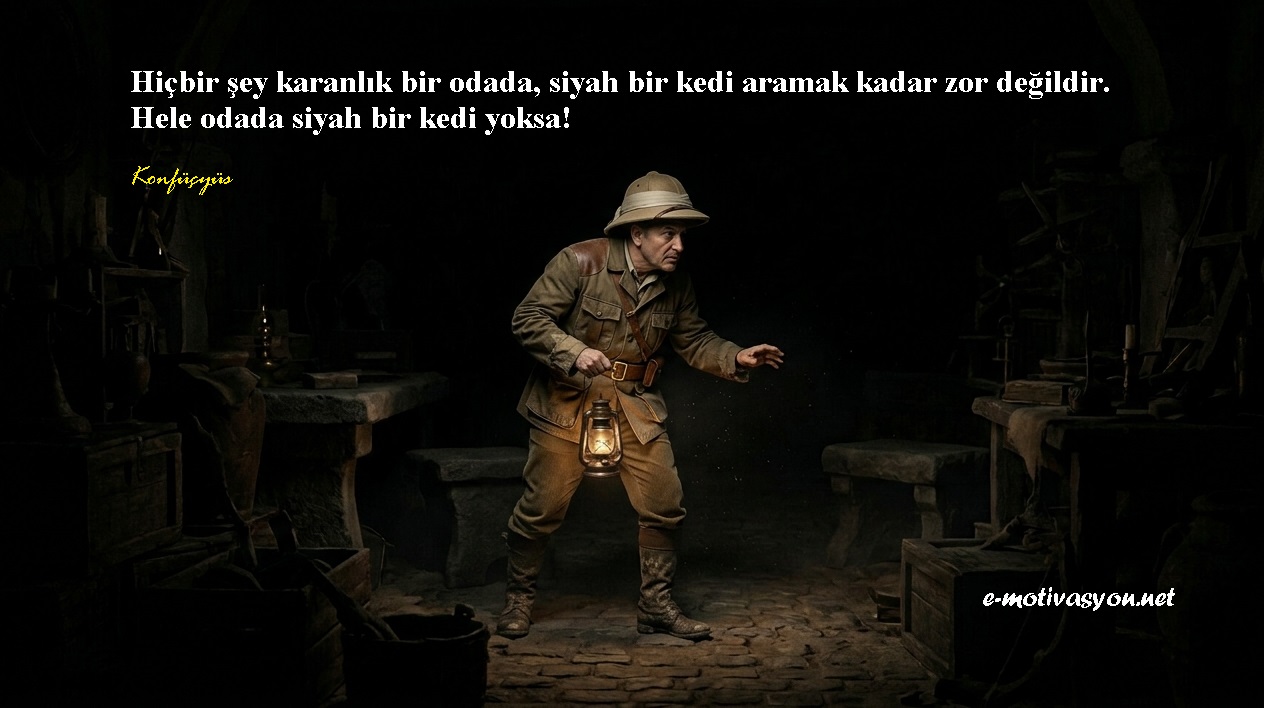
Nothing is as difficult as looking for a black cat in a dark room—especially if there isn’t a black cat in the room!” This saying reflects one of Confucius’s profound observations about the fallibilities of the human mind. It essentially illustrates how, in our lives, we often chase after problems in the wrong places, using the wrong methods, or even pursuing problems that don’t exist. Sometimes we believe the answers lie in the external world, seek complex explanations, or try to solve problems that have no solution. Yet the real issue is that we fail to question whether what we’re searching for actually exists. Here, Confucius reminds us with wisdom: Any search undertaken without asking the right question only exhausts the person and deepens mental darkness. Clarity in life often arises not from exerting more effort, but from developing the right perspective.
Inspired by this saying, here is a practical suggestion we can apply in our daily lives: When you encounter a problem, first ask yourself this question: “Is there really a problem I need to solve, or is my mind blowing it out of proportion?” Especially in stressful moments, our minds generate assumptions and drag us into unnecessary worries. That’s why pausing to define the problem is a more important first step than searching for a solution. Writing down the problem you’re facing on a small piece of paper and then asking, “What’s my evidence?” helps clarify our thoughts. This allows us to direct our energy toward real areas for growth rather than imaginary fears. This approach strengthens our ability to be mindful and make conscious decisions.
Let’s consider a simple example from everyday life: If a friend takes a while to reply to your message, you might start imagining the worst. Yet there may not be a real problem; perhaps they’re just busy. We often lose our peace of mind while searching for a cat that isn’t even in the dark room. Confucius’s wisdom shows us that what makes life difficult is often not the events themselves, but our interpretations of them. True wisdom isn’t about trying to solve everything; it’s about first realizing whether there’s actually something that needs to be solved.
Who is Confucius?
Confucius (551–479 BCE) was a Chinese philosopher, thinker, and educator. His teachings on moral philosophy, virtuous living, social order, and human relationships are regarded as one of the cornerstones of Eastern thought. His teachings have influenced the ethical understanding, educational systems, and governance philosophies of many Asian societies, particularly in China, for centuries. Confucius is known for his ideas advocating self-improvement, moderation, the pursuit of wisdom, and the notion that proper conduct is the foundation of social harmony.

Motivasyonunuzu tazelemek için şu kısa videoya göz atın.
Farklı Kategorilerde En İyi Özlü Sözler
- Best Motivational Quotes
- En İyi Özgüven Sözleri
- En İyi Cesaret Sözleri
- En İyi Kararlılık Sözleri
- En İyi Başarı Sözleri
- En İyi Çalışkanlık Sözleri
- Best Personal Development Quotes
- En İyi Mutluluk Sözleri
- En İyi Umut Sözleri
- En İyi Özgürlük Sözleri
- En İyi Düş ve Hayal Sözleri
- En İyi Zenginlik ve Para Sözleri
- En İyi Eğitim ve Öğretim Sözleri
- En İyi Girişimcilik Sözleri
- En İyi Bilim ve Bilgelik Sözleri
- En İyi Yaratıcılık Sözleri
- En İyi Film Replikleri
- En İyi Seçim ve Karar Sözleri
- En İyi Değişim Sözleri
- En İyi Sevgi ve Aşk Sözleri